New Delhi, 17–19 September 2026 — Yashobhoomi (IICC), Dwarka
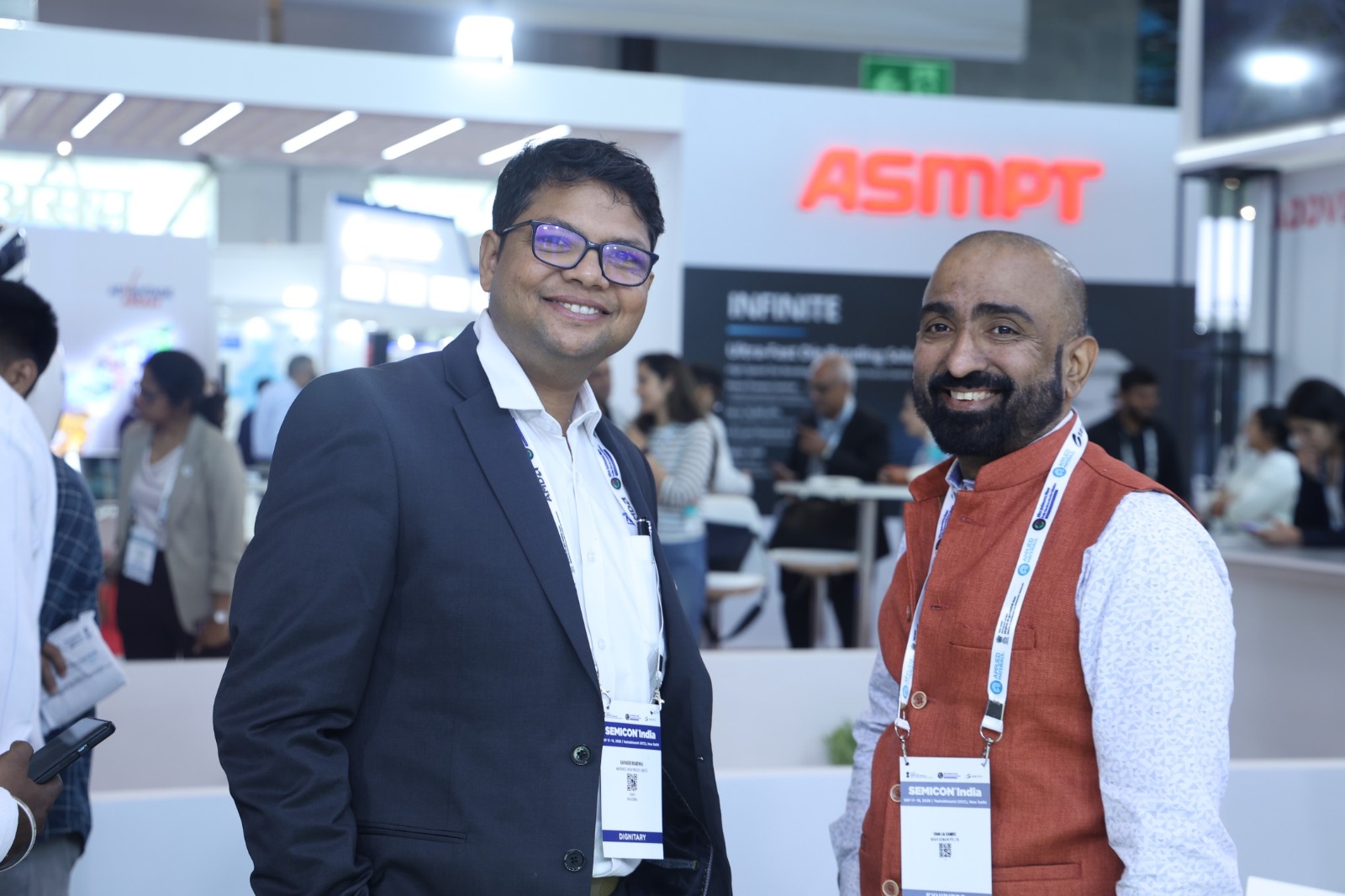
Ravinder Bhardwaj, ISTC 1997 batch and Vice President, NMTronics, with Sham Kamboj, ISTC 1994 batch and Founder, Fidus ONE, at SEMICON India 2026.
Three days at Yashobhoomi. More than 600 exhibitors. Participation from 52 countries. Around 40,000 cumulative footfall. And 56 MoUs, announcements and strategic initiatives by the time SEMICON India 2026 closed on 19 September.
Prime Minister Narendra Modi inaugurated the event on 17 September.
And somewhere in the middle of all that, standing among die bonders, wafer-handling systems, automation equipment and semiconductor manufacturing technology, a thought that has been forming for some time landed properly.
Much of what we saw on that exhibition floor depends on the kind of engineering discipline ISTCians understand very well.
Not necessarily chip design. Not software.
The machines.
Die bonders, wire bonders, wafer handlers, vacuum systems, gas delivery systems, metrology equipment, automation and precision manufacturing systems.
They demand precision, process discipline, measurement, equipment understanding and the ability to recognise when something is moving outside specification.
Those ideas sound remarkably familiar to generations of ISTCians.
An ISTCian Already Has a Booth
One of the particularly satisfying moments at SEMICON India 2026 was seeing an ISTCian exhibiting as part of the semiconductor ecosystem.
Booth 1127 belonged to Brain Domain Semiconductor Solutions, founded by Sandeep Sharma of the ISTC 1986 batch.
Brain Domain was presenting its semiconductor capabilities, including its talent-development initiative BDUni, built around semiconductor infrastructure, equipment, curriculum and certification.
Think about that for a moment.
An ISTCian, four decades after his own training, exhibiting at India's flagship semiconductor event and working on the development of capabilities needed by a completely new generation of engineers and technicians.
That connection is worth paying attention to.
Learn more about Brain Domain:
brain-domain.com
From the 1986 Batch to the 2022 Batch
Brain Domain was not the only ISTC connection on the exhibition floor.
Across the event we encountered ISTCians representing different companies, technologies and parts of the semiconductor and electronics ecosystem.
The remarkable part was the span.
From the 1986 batch to the 2022 batch.
Nearly four decades of ISTC generations were present at the same event, participating in an industry that is only now beginning to develop at scale in India.
Different batches. Different companies. Different technologies.
But a surprisingly common engineering foundation.
What ISTC Actually Gave Us
It is important not to overstate the connection.
ISTC does not train semiconductor engineers and historically was not created for the semiconductor industry.
ISTC was established in 1963 through Indo-Swiss cooperation and built its reputation around practical technical education and precision engineering.
Across generations, ISTCians have trained in areas including mechanical engineering, electronics, instrumentation, die and mould, mechatronics, industrial automation, tooling and special-purpose machines.
But beyond the course names, there was another layer to the training:
- Working to tolerance on equipment where carelessness has consequences
- Setting up a machine correctly before starting the job
- Understanding when a process is beginning to drift
- Measuring correctly — and trusting the measurement
- Finishing work to a standard that somebody else will inspect
- Learning through machines, workshops and practical problem-solving
Now look at the requirements of semiconductor manufacturing and advanced packaging.
Cleanroom discipline. Precision handling. Equipment setup. Process control. Measurement. Documentation. Maintenance. Automation. Quality.
The technology is different. Some of the engineering discipline is remarkably familiar.
India Is Building the Industry — and Now Needs the People
SEMICON India 2026 made the scale of India's semiconductor ambition difficult to miss.
The event brought together more than 600 exhibitors, around 300 of them international, with representation from 52 countries.
Across the three days, 56 MoUs, announcements and strategic initiatives were recorded across design, manufacturing, packaging, materials, equipment, R&D, startups and talent.
Semicon 2.0 is also placing explicit emphasis on workforce development, including a stated objective of training one lakh technicians.
That last number should interest ISTCians.
Because semiconductor manufacturing does not run only on chip designers and researchers.
It also requires equipment engineers, maintenance professionals, process technicians, automation specialists, manufacturing engineers, quality personnel and trained operators.
The talent pyramid gets much broader as you move closer to the manufacturing floor.
The Training Infrastructure Question
India already has nationally recognised semiconductor skilling initiatives and qualification frameworks emerging across the ecosystem.
But curriculum alone cannot produce a manufacturing-ready technician.
Practical semiconductor training eventually needs infrastructure: controlled environments, relevant equipment, trained instructors, assessment systems and meaningful connections with employers.
That distinction should be particularly easy for an ISTCian to understand.
We know the difference between reading about a machine and learning on one.
Fidus ONE is working with Brain Domain in this area, focusing on semiconductor talent enablement and the development of hands-on OSAT/ATMP training capabilities for institutions.
More about this work:
fidus.one/semiconductor
Why We Are Writing This on ISTCKonnect
Because ISTCKonnect may already contain part of the talent the semiconductor ecosystem is trying to find.
Across this network are ISTCians with ten, twenty, thirty and even forty years of experience in manufacturing, tooling, automation, electronics, instrumentation, maintenance, quality and precision engineering.
They are working across India and around the world.
Some are already in semiconductors.
Others may be much closer to the industry than they realise.
If You Are an ISTCian, Here Is Where You Might Fit
- Already working in semiconductors? Add it to your ISTCKonnect profile. Let the network discover you.
- Working in equipment, tooling, automation or maintenance? Many underlying engineering capabilities transfer, even though semiconductor-specific training will still be required.
- Teaching at a polytechnic, ITI or engineering institution? Semiconductor workforce development may become an increasingly important area for industry-academia collaboration.
- Working for a company that hires technicians or engineers? Your connection with technical institutions could help create a much more direct industry-to-training pipeline.
Read the Deeper Research
We have explored the semiconductor talent question in considerably greater detail through Fidus ONE:
-
From ISTC to Industry — Sixty Years of the Base Tier
The ISTC story, the Chandigarh–Mohali engineering corridor and the infrastructure required for meaningful semiconductor training. -
The National Semiconductor Talent Pyramid
A look at where technicians, engineers and specialised semiconductor talent fit within India's emerging workforce. -
56 Announcements at SEMICON India 2026
A closer examination of the announcements made during the event and what they reveal about semiconductor talent development. -
Setting Up an OSAT / ATMP Training Programme
A practical framework for institutions considering semiconductor manufacturing training.
And This Is Happening Close to Home
There is another reason this conversation should matter particularly to the ISTC community.
Semiconductor Laboratory (SCL) Mohali sits roughly in ISTC's own regional industrial ecosystem and has been part of India's semiconductor story since the 1980s.
The Government of India has announced a ₹4,500 crore modernisation and expansion programme for SCL Mohali.
At SEMICON India 2026, commercial production at CDIL Semiconductor in Mohali was also inaugurated virtually.
The semiconductor story is therefore not happening only in Gujarat, Assam, Bengaluru or distant global technology hubs.
Part of it is happening here.
In the same Chandigarh–Mohali region where generations of ISTCians learned precision engineering.
One Last Thing
Seeing ISTCians from the 1986 batch through to the 2022 batch participating at SEMICON India 2026 made something very clear.
An alumni network should not simply tell us where people studied.
It should help us discover what they know, what they are building and where generations of experience can meet new opportunities.
A senior ISTCian may understand an industry.
A younger ISTCian may understand the newest automation systems.
Another may manufacture tooling.
Another may maintain the equipment.
Another may train technicians.
Another may build a company.
Put those connections together and an alumni directory becomes an engineering network.
India is building a semiconductor industry.
Perhaps it is time to find out how many ISTCians are already helping build it.
If you attended SEMICON India 2026, or if you are an ISTCian working anywhere in the semiconductor ecosystem, update your ISTCKonnect profile or connect with us. Let's map the ISTCian semiconductor network.
— Sham Kamboj, ISTC 1994 batch