Electronics is not a sector. It is the infrastructure that every other sector runs on.
The smartphone. The ECG machine. The industrial sensor that detects a fault in a motor before the motor overheats. The embedded controller in a car that manages fuel injection 200 times per second. The circuit board in a satellite. The power supply in a hospital. Every one of these contains electronics designed, assembled, tested, and maintained by electronics engineers.
India manufactures over 300 million smartphones a year. It is scaling semiconductor production, building EV factories, expanding its defence electronics programme, and running one of the world's largest telecom networks. Behind all of it — the components, the circuits, the embedded systems — there are electronics engineers. And the demand for people who can actually build and troubleshoot electronic systems, not just describe them theoretically, consistently outpaces supply.
What the ISTC Electronics Engineering programme covers
ISTC offers a Diploma in Electronics Engineering — a three-year programme across six semesters, admitting 60 students per year. It is the largest programme at the institute, and it reflects the breadth of electronics as a field. The training follows the ISTC model: hands-on, workshop-first, built on Swiss technical education principles that have shaped the institute since 1963.
The curriculum covers:
- Circuit design and analysis — DC and AC circuit theory, network theorems, practical circuit construction and testing
- Electronic devices — diodes, transistors, MOSFETs, operational amplifiers, and their applications in real circuits
- Digital electronics — logic gates, combinational and sequential circuits, microprocessors, microcontrollers
- Embedded systems — programming microcontrollers, interfacing sensors and actuators, real-time system design
- Communication systems — signal modulation, wireless communication fundamentals, antenna theory
- Industrial electronics — power electronics, motor drives, industrial control systems, PLCs
- Instrumentation — measurement systems, transducers, data acquisition, calibration
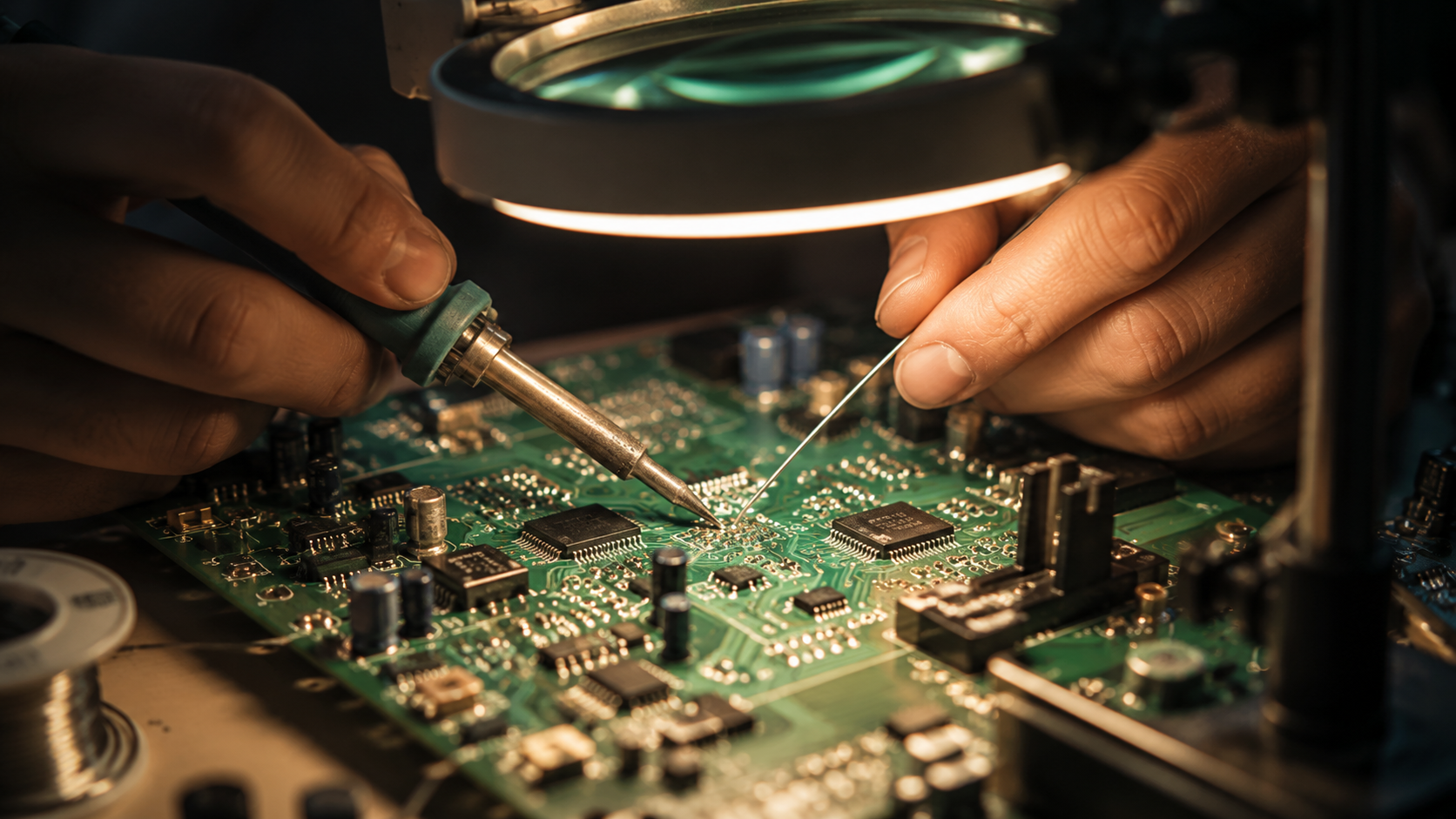
- PCB design — printed circuit board layout, prototyping, soldering, testing
By the end of three years, an ISTC Electronics graduate has built circuits, programmed microcontrollers, designed and tested PCBs, and worked with industrial control systems. The difference between understanding a circuit on paper and being able to build one, debug it, and make it work — that difference is what three years at ISTC produces.
Where Electronics Engineering diploma holders work
The electronics engineering field in India currently spans multiple high-growth sectors, and diploma graduates from well-trained institutes are in consistent demand across all of them.
Consumer electronics and manufacturing — assembly, quality control, and testing in electronics manufacturing facilities. Every smartphone, television, and appliance produced in India goes through testing processes that require electronics engineers who understand the devices.
Automotive electronics — modern vehicles contain over 100 electronic control units (ECUs). The EV transition is accelerating this further, with battery management systems, motor controllers, and charging electronics all requiring trained engineers to build, test, and maintain them.
Telecom and networking — India's 5G rollout requires field engineers who understand the equipment at a technical level. Network infrastructure installation, maintenance, and troubleshooting is a large and growing employment segment.
Industrial automation — the same Industry 4.0 transition that is driving demand for Mechatronics engineers is creating demand for Electronics engineers who understand the sensing, control, and communication layers of automated systems. Addverb Technologies, which recruits from ISTC, builds autonomous robots and warehousing systems that require exactly this skill set.
Medical devices — diagnostic equipment, patient monitoring systems, and surgical instruments all require electronics engineers for manufacturing quality control, installation, and maintenance.
Defence and aerospace — India's expanding defence production programme, with its emphasis on domestic manufacturing, is a growing employer of electronics engineers in avionics, radar systems, and communication equipment.
Entry-level salaries for electronics diploma engineers in India range from ₹3.5 to ₹5.5 LPA, depending on the sector and employer. With 3-5 years of experience in embedded systems, industrial automation, or telecom infrastructure, that range moves to ₹7-12 LPA. Specialists in power electronics, VLSI, or RF systems command significantly more.
60 seats — and why that number matters
ISTC's Electronics Engineering programme takes 60 students per year — the largest cohort at the institute. This reflects both the breadth of the field and the institute's capacity to train at scale while maintaining the quality that comes from actual hands-on work.
In a batch of 60, every student still uses the equipment. The lab sessions are structured around doing, not observing. Every student who leaves ISTC has built real circuits, not watched demonstrations. In a field as broad as Electronics — where the graduate might go into consumer electronics assembly, embedded systems programming, or industrial instrumentation — the foundation of knowing how to work with actual electronic hardware and instruments is what makes every subsequent specialisation possible.
Electronics now — and in five years
A student who joins ISTC's Electronics programme in 2026 graduates in 2029. By 2029, India's semiconductor mission will have matured. The EV fleet on Indian roads will have multiplied. 5G will be in every major city and most towns. The defence electronics programme will have moved further toward domestic production. The Internet of Things — sensors, actuators, and controllers embedded in industrial equipment, infrastructure, and consumer devices — will have grown from a trend into standard practice.
Every one of these developments requires electronics engineers who can actually work with the hardware. Not describe it. Not simulate it. Build it, test it, troubleshoot it when it fails, and improve it when it works.
Three years at ISTC is what produces that capability.
👉 Diploma in Electronics Engineering at ISTC — course details, eligibility, fees
👉 ISTC Entrance Exam Result 2026 — merit list and counselling schedule
👉 ISTC Admissions 2026-27 — complete guide
ISTC Chandigarh: CSIR-CSIO, Sector 30-C, Chandigarh 160030 | 0172-2672484 | istc.ac.in