Most students approaching Class 10 board exams are told to think in binaries. Get good marks, go to Class 11-12, then do engineering or medicine. The diploma path is framed as the alternative for those who did not make it — a shorter route, a smaller destination.
ISTC does not fit that story. It never has.
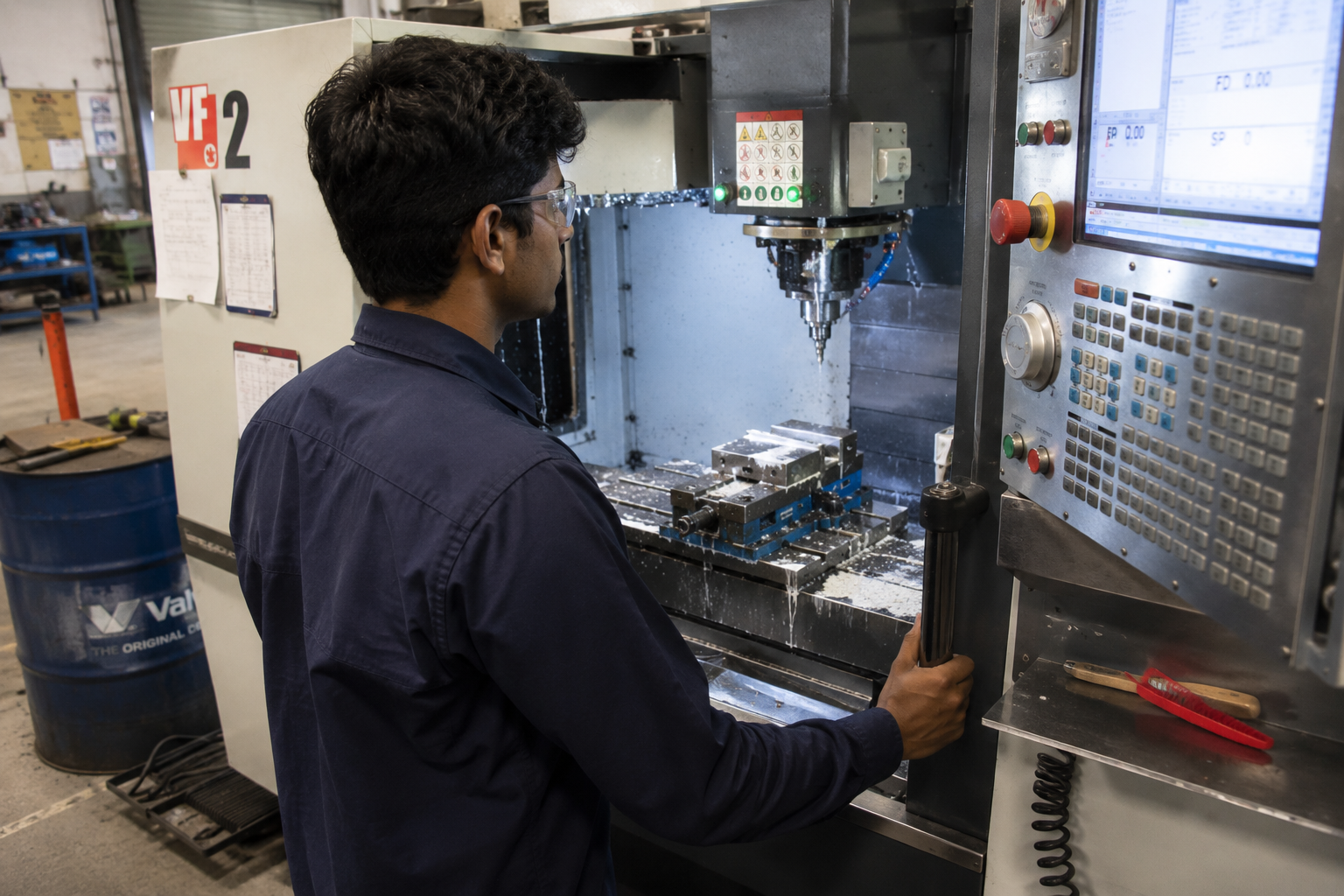
Students who join Indo Swiss Training Centre after Class 10 enter a three-year programme built on Swiss engineering principles — where the workshop is not supplementary to the classroom, it is the classroom. By the time an ISTC graduate completes the programme, they have worked with precision machinery, understood manufacturing processes at a depth that most B.Tech graduates encounter only in their final year projects, and trained in an environment that has been producing industry-ready engineers since 1963.
What happens after that diploma is not a single road. It is a fork. And both paths are genuinely good.
The first path: direct placement
ISTC graduates are placed at companies that recognise what the diploma actually represents. Maruti Suzuki, Addverb Technologies, Dr. Reddy's Laboratories, ISGEC Heavy Engineering, Godrej, Rockpecker Global — these are not companies that hire as a favour to an institute. They hire from ISTC because the graduates can do the work from the first week.
The practical depth of the training makes ISTC graduates different from candidates who have only studied engineering theoretically. When a Mechatronics graduate from ISTC joins a manufacturing line, they are not learning the machines for the first time. They already know them.
This is the path most ISTC graduates take. Industry finds them. The placement record of the institute speaks to that consistently.
The second path: B.Tech through lateral entry
For students who complete their ISTC diploma and decide they want a degree — that door remains open. Completely open.
The Government of India and AICTE recognise 3-year engineering diplomas for lateral entry admission into B.Tech programmes. Diploma holders with a minimum of 50% aggregate marks are eligible for direct admission to the second year — the third semester — of any AICTE-approved B.Tech programme. They skip the first year entirely.
This is not a workaround. It is a formal, recognised pathway. The resulting B.Tech degree carries the same academic value as a regular four-year degree. It is accepted for employment, government job eligibility, promotions, and higher education including M.Tech and MBA.
The lateral entry route reduces the B.Tech from four years to three — since the first year is waived. Add that to the three years at ISTC, and a student who starts after Class 10 can have both a diploma and a full engineering degree by the age of 21 or 22.
What the combination actually produces
A student who takes the lateral entry route after ISTC arrives at the second year of B.Tech with something most of their classmates do not have: genuine hands-on experience. The precision engineering and workshop training from ISTC does not disappear when you enter a degree programme — it compounds. The theory in the B.Tech classroom lands differently when you already understand what it describes in practice.
Universities accepting lateral entry in India include institutions like Thapar University (Patiala), Manipal Institute of Technology, COEP Pune, Jadavpur University (Kolkata), Anna University, and many others — across Mechanical, Electronics, Mechatronics, and Computer Science streams.
Many states also conduct a LEET (Lateral Entry Entrance Test) for admission to government engineering colleges through this route — making it accessible at every budget level.
The choice belongs to the student
This is not a choice that needs to be made on the day of admission to ISTC. It is a choice that can be made after three years of real training, with full information about what both paths look like from the inside.
Some ISTC graduates take placement at 18 or 19, begin earning, and pursue a degree later through distance or part-time programmes if they choose to. Some go directly to B.Tech lateral entry. Some join companies and find that the career they wanted does not require a degree at all.
What ISTC provides is not a single outcome. It is a foundation strong enough to support multiple outcomes — and the credibility to make any of them real.
That is what 63 years of Swiss engineering training produces. Not one door. Two — and the preparation to walk through either one.
👉 ISTC Admissions 2026-27 — courses, eligibility, entrance exam details
👉 ISTC Entrance Exam Result 2026 — merit list, cut off, counselling
About ISTC: Indo Swiss Training Centre, CSIR-CSIO, Sector 30-C, Chandigarh 160030. istc.ac.in | 0172-2672484