Mechatronics is one of those words that sounds more complicated than it is. Strip it down and it describes something that has existed in every factory and production line for decades: the point where a mechanical system, an electronic control, and a piece of software meet and work together.
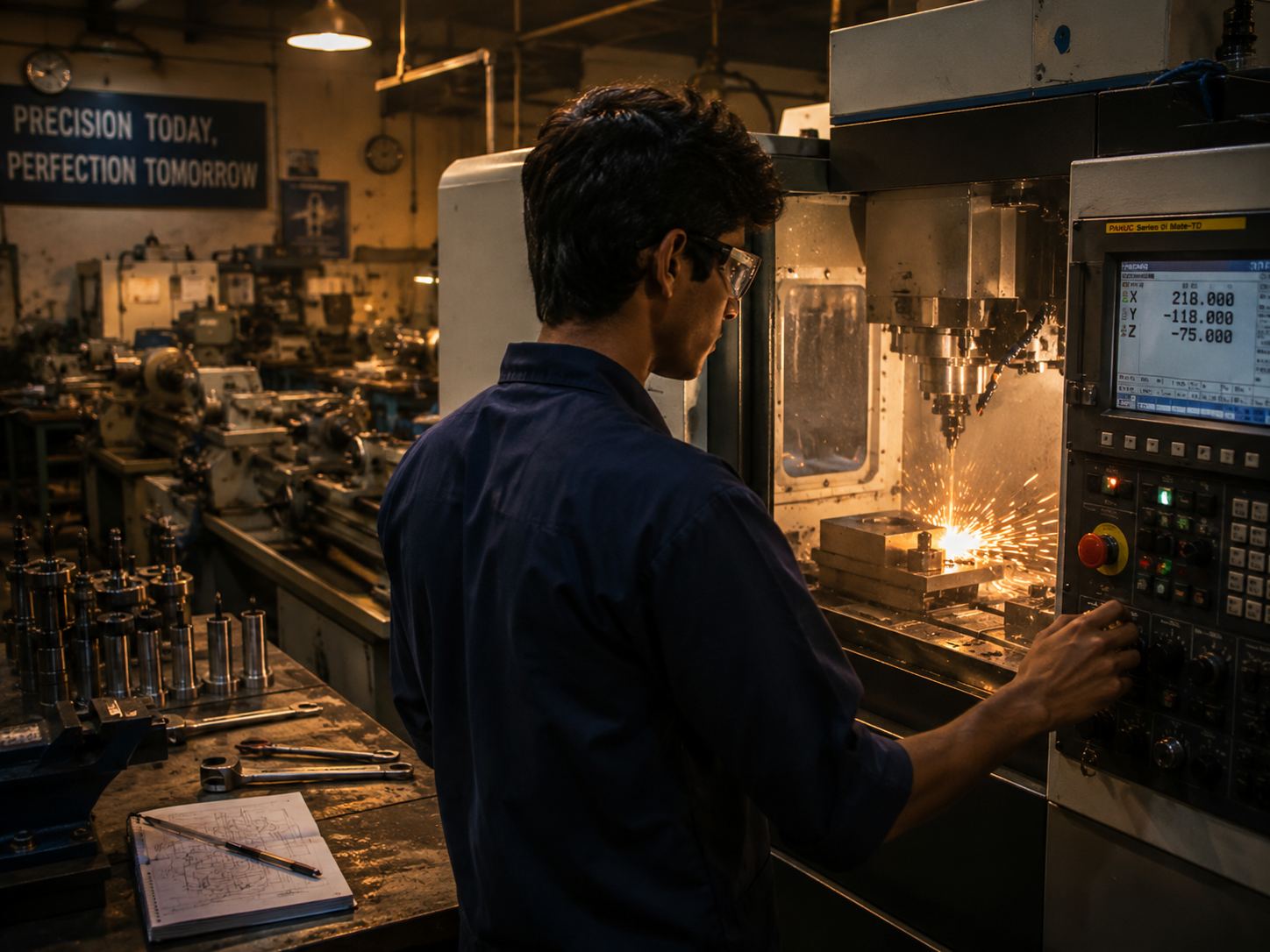
A robotic arm on an automotive assembly line. A CNC machine cutting a precision component to 0.01mm tolerance. The automated conveyor system at a warehouse. The sensors that detect a fault in an industrial motor before the motor itself knows something is wrong. All of these are mechatronics — the integration of mechanical engineering, electronics, and control systems into a single functioning unit.
What has changed is that the world now needs people who can build, operate, and maintain these systems at scale. Every factory moving toward automation, every EV manufacturer scaling production, every logistics company replacing manual sorting with robotics — they all need engineers who understand the machine, the electronics, and the software simultaneously. Specialists in just one of these areas are not enough anymore.
What the course actually teaches
The Advanced Diploma in Mechatronics & Industrial Automation at ISTC is a four-year programme across eight semesters. It is not a theoretical introduction to multiple engineering fields. It is a hands-on programme built around the workshop — which at ISTC means precision machinery, real industrial equipment, and training methods inherited from the Swiss vocational education system that the institute was built on in 1963.
The course covers:
- Mechanical systems — precision engineering, machine elements, manufacturing processes, CNC machining
- Electronics and electrical systems — circuit design, sensors, actuators, power electronics
- Control systems — PLC programming (Programmable Logic Controllers), feedback systems, industrial automation protocols
- Robotics — robot kinematics, industrial robot programming, automation cells
- CAD/CAM — computer-aided design and manufacturing, simulation, digital manufacturing tools
By the end of four years, an ISTC Mechatronics graduate has not read about CNC machines in a textbook. They have operated them. They have not studied PLC programming in theory. They have written programmes that ran on actual industrial equipment. That difference — between knowing about something and being able to do it — is what the Swiss training model is built around, and what ISTC has carried forward for over six decades.
The industry that is waiting for you
India's manufacturing sector is undergoing the fastest period of automation in its history. The National Policy for Advanced Manufacturing, the Production Linked Incentive (PLI) schemes across 14 sectors, and the push toward Industry 4.0 — smart factories, Industrial IoT, data-driven manufacturing — have created a demand for mechatronics-trained engineers that far outpaces supply.
The sectors hiring mechatronics engineers in India right now include:
- Automotive — Maruti Suzuki, Tata Motors, Bajaj, Hero, and the entire EV ecosystem scaling production rapidly
- Robotics and automation — companies like Addverb Technologies (which recruits from ISTC) are building autonomous warehouses, automated sorting systems, and AI-integrated logistics robots
- Aerospace and defence — precision manufacturing and automated assembly
- Healthcare equipment — surgical robots, diagnostic devices, medical manufacturing
- Consumer electronics manufacturing — automated production lines for smartphones, appliances
Entry-level salaries for mechatronics engineers in India currently range from ₹4.5 to ₹8 LPA. With 3-5 years of experience in automation or robotics, that range moves to ₹10-16 LPA. Senior roles in industrial automation and robotics reach ₹20 LPA and above. The trajectory is steeper than most traditional engineering streams because the skills are genuinely scarce relative to demand.
30 seats. Four years. A specific kind of training.
ISTC admits 30 students into the Mechatronics & Industrial Automation programme each year. That number is not an accident. A batch of 30 allows every student to actually use the equipment — not watch a demonstration, not queue for their turn on a shared machine during a lab session, but work.
The four-year Advanced Diploma structure also allows the curriculum to go deeper than a three-year programme. By the third and fourth year, students are working on automation projects, integrating control systems with mechanical assemblies, and building the kind of problem-solving capability that takes most B.Tech graduates two to three years on the job to develop.
Graduates of this programme have been placed at companies like Maruti Suzuki and Addverb Technologies — and those are not the ceiling. They are the floor that a well-trained ISTC Mechatronics graduate starts from.
Why this moment matters for Mechatronics
The engineers who get trained in mechatronics today are entering the workforce at exactly the inflection point of Indian manufacturing's automation wave. The PLI schemes are pulling manufacturing into India. The EV transition is rebuilding entire production ecosystems. The logistics and warehousing sector is going from manual to automated. Every one of these transitions requires people who understand the systems that run them.
A student who joins ISTC's Mechatronics programme in 2026 will graduate in 2030. By 2030, the factories that are being designed today will be running at scale. The engineers who trained on the actual machinery — not simulations, not textbook problems — are the ones those factories will be looking for.
ISTC has been producing exactly those engineers since before most Indian colleges had a course called Mechatronics. That institutional knowledge — built across decades, embedded in the training methods, expressed in the equipment and the workshops — does not appear in a curriculum document. It appears in what the graduates can do when they start work.
👉 Advanced Diploma in Mechatronics & Industrial Automation — course details
👉 ISTC Entrance Exam Result 2026 — merit list and counselling schedule
👉 ISTC Admissions 2026-27 — eligibility, fees, selection process
ISTC Chandigarh: CSIR-CSIO, Sector 30-C, Chandigarh 160030 | 0172-2672484 | istc.ac.in