
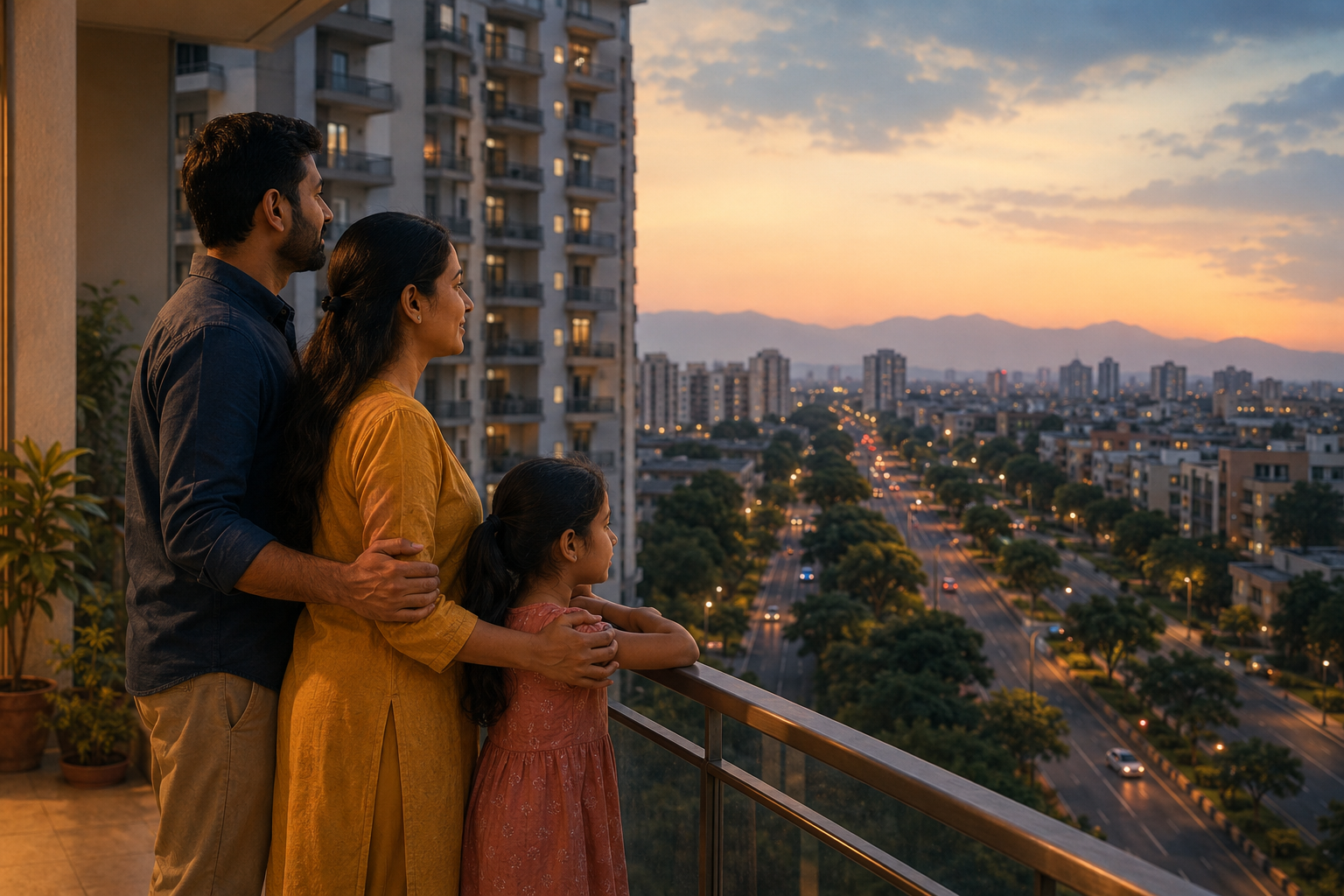
At some point, every ISTCian who ends up working in the Tricity region faces the same conversation with their partner. The lease is up. The kids are getting older. The commute from a rented 2 BHK in Zirakpur or Kharar is survivable but not ideal. And the question arrives quietly, then louder: do we buy something here, or keep waiting?
This is that article. Not a builder's brochure. Not a vague "Tricity is booming" piece. A practical guide for a nuclear family with two working adults, one or two children, and a specific situation — rooted in Chandigarh, working in the Mohali corridor, and wondering what home ownership actually looks like in 2026.
Why ISTCians End Up in Tricity
The answer is obvious but worth stating. ISTC is on the CSIO campus in Sector 30-C, Chandigarh. The institute has placed alumni across Tata Steel, Microsoft, Honda, Samsung, Godrej, and hundreds of smaller precision engineering and automation firms. A large portion of those firms — especially the newer ones in mechatronics, industrial automation, and electronics manufacturing — have operations in or near Mohali's IT City, the Phase industrial areas, or the GMADA Aerocity corridor.
Add to that the 450-plus alumni-founded businesses, many of them in the Tricity region, and the pull becomes structural rather than coincidental. ISTCians work here. They build here. Their families are here. The only question is whether they own or rent.
The Case for Buying in 2026 (and the case against rushing)
Mohali's residential market in 2026 is not a bubble story or a distress story. It is a maturation story. The city has grown into its infrastructure — wide sector roads, functioning drainage, reliable power, and an airport that now connects to 14 domestic and international destinations. The buyers who entered in 2020–2022 are sitting on meaningful appreciation, particularly in Sectors 82, 88, and 91.
For a first-time buyer in a nuclear family, the honest calculus looks like this:
Buy if: You are in a stable dual-income household, you intend to stay in the Tricity region for at least seven to ten years, and you have a down payment of ₹15–25 lakh without liquidating an emergency fund.
Wait if: Your income is primarily from a single earner, you are within two years of a potential relocation, or you are looking at a ready-to-move flat above ₹1.5 crore where the EMI would exceed 40% of take-home.
The market is not going anywhere dramatically in either direction in the next 12 months. You have time to decide clearly rather than emotionally.
The Sector Guide: Where a Family Actually Wants to Live
Not every sector in Mohali is equal for a family with children. Here is a practical breakdown based on what matters — schools, hospitals, daily convenience, and whether the roads are actually usable.
Sector 82, 88, 91 — the established core
These three sectors form Mohali's most liveable residential belt. School infrastructure is functional: Strawberry Fields, Bhavan Vidyalaya, and several CBSE schools are within reach. Fortis Hospital is eight minutes from Sector 88. Markets are developed. Auto-rickshaw and cab availability is decent. A 3 BHK flat of 1,600–1,900 sqft in a gated society here runs between ₹80 lakh and ₹1.3 crore depending on builder reputation and age of the building.
The honest trade-off: older stock from 2010–2015 is priced attractively but often comes with maintenance issues. Newer projects in the same sectors are better built but command a significant premium.
Sector 115, Landran Road — the value corridor
If ₹80 lakh is your ceiling and you need three bedrooms, Sector 115 and the Landran Road belt are where the math works. The trade-off is commute — you are 20–25 minutes from Chandigarh on a clear day, more during peak hours. For an ISTCian working at a Mohali-based firm rather than in Chandigarh proper, this belt makes strong practical sense.
Kharar belt — the long game
Kharar and the Banur Road axis have attracted buyers priced out of core Mohali. The Kharar-Banur belt currently averages ₹4,300–₹4,750 per sqft, making a 1,400 sqft 3 BHK achievable under ₹70 lakh. NH-205A connectivity to IT City is improving; the Ambala-Chandigarh Greenfield Corridor stretch through this belt is reportedly 89% complete as of mid-2026. If you are buying for a seven-plus year horizon, this is a reasonable bet.
Aerocity, Sector 66/67 — premium tier
If the household income supports an EMI above ₹70,000 per month, the Airport Road and IT City-adjacent sectors offer quality that is genuinely different — larger floor plates, better builders, stronger resale liquidity. Sectors 66, 67, 68, and 82A are where the premium 3 BHK market lives. Expect ₹1.4–₹2.5 crore for a 1,800–2,500 sqft unit from a reputed developer.
The 3 BHK vs Plot Debate Every ISTCian Has
A significant fraction of ISTCians eventually arrive at the same question: why buy a flat in someone else's building when I can buy a 100–150 sqyd plot and build exactly what I want?
The case for a plot is real. ISTCians, trained in precision and construction logic, often have the ability to supervise a build that most buyers don't. A 150 sqyd plot in Sector 82 or 88 at ₹1–1.2 lakh per sqyd gives you land at ₹1.5–1.8 crore. Construction of a G+2 kothi at ₹2,500/sqft runs another ₹30–40 lakh. Total outgo is higher, timeline is 18–24 months, and you need to manage the build actively.
The case against: construction supervision is a part-time job. With two working adults and children in school, the bandwidth for site visits, contractor management, and material procurement is often not there. The flat wins on convenience, financing, and certainty of timeline.
What ₹80L, ₹1.2Cr, and ₹2Cr Gets You Right Now
₹80 lakh — A 1,400–1,600 sqft 3 BHK in Sector 115, Landran Road, or Kharar belt. GMADA-approved gated society, covered parking, lift. Older stock in Sectors 82/88 is also available in this range.
₹1.2 crore — A 1,700–2,000 sqft 3 BHK in Sectors 82, 88, or 91 from a mid-tier builder. Relatively new construction (post-2018), gated, clubhouse. This is the genuine sweet spot for a dual-income family in the ₹1.5–2 lakh per month household income bracket.
₹2 crore — A 2,000–2,400 sqft 3 BHK on Airport Road or in IT City-adjacent sectors (66, 67, 68). Premium builders — JLPL, Wave, Emaar, Marbella. Larger floor plates, better common areas, stronger resale. Current active inventory of 3 BHK flats in Mohali across all segments runs above 1,700 units, with the market refreshing continuously from dealer feeds.
The Commute Math
ISTC campus in Sector 30-C, Chandigarh, sits 10.2 km from Shaheed Bhagat Singh International Airport. Approximate drive times from ISTC campus (non-peak):
- Sector 82, Mohali: 18–22 minutes
- Sector 88/91, Mohali: 20–25 minutes
- IT City (Sector 66B/82A): 22–28 minutes
- Sector 115/Landran Road: 28–35 minutes
- Kharar: 30–40 minutes
- Airport (IXC): 12–15 minutes
For a family where one partner works in Chandigarh and the other in Mohali, Sectors 82/88/91 sit at a reasonable midpoint for both commutes without over-optimising for either.
A Word on RERA and What to Verify
Punjab RERA registration is non-negotiable. Before any payment — even a token amount — verify the project's RERA registration at rera.punjab.gov.in. Check that the registered carpet area matches what the builder is quoting. In Punjab, the loading on group housing projects ranges from 25% to as high as 45% in some cases. A 1,900 sqft super area unit can have a carpet area as low as 1,100 sqft after all deductions. Always ask for carpet area in writing before signing.
For resale flats, check the occupancy certificate. Many older Mohali projects are occupied but do not have a formal OC from GMADA — this creates complications at the time of resale and for home loan approvals from nationalised banks.
The Bottom Line
Tricity in 2026 is a functional, liveable region for a nuclear family. It is not perfect — traffic on the Zirakpur bypass is genuinely bad during peak hours, and some sectors have had power reliability issues. But relative to comparable cities in north India, the planned infrastructure, hospital quality, school options, and proximity to the airport make it a reasonable long-term base.
For an ISTCian family, the calculus is stronger than average. The professional network is here. The alumni-founded businesses are here. The CSIO campus — which many ISTCians return to for collaborations and events — is here. Buying in Mohali is not just a real estate decision; it is a decision to embed more deeply in the community where the network already lives.
The market has inventory. The prices are not cheap, but they are not speculative either. The research is worth doing carefully, and the decision is worth making deliberately.
Data referenced in this article draws on publicly available market sources and the live listings database at mohaliaerotropolis.com. This article is editorial in nature and does not constitute real estate advisory. Verify all project details with RERA Punjab before making any payments.